

What Saint Norbert saw
He was about thirty-five years old when it happened. He was riding on his horse, dressed magnificently and accompanied by a young page. It was a beautiful spring day, and he was probably on his way to visit a lovely lady. As the two riders crossed a large field, a thunderstorm unexpectedly broke out. Lightning flashed, and his horse reared. Norbert fell to the ground, unconscious. When he came back to consciousness an hour later, with his frightened servant by his side, the first words on his lips were those of Saint Paul.
“Lord, what do You want me to do (Acts 22:10)?”
In his heart, he heard the Lord’s answer from Psalm 34:14: “Turn away from evil and do good: seek peace and pursue it.”
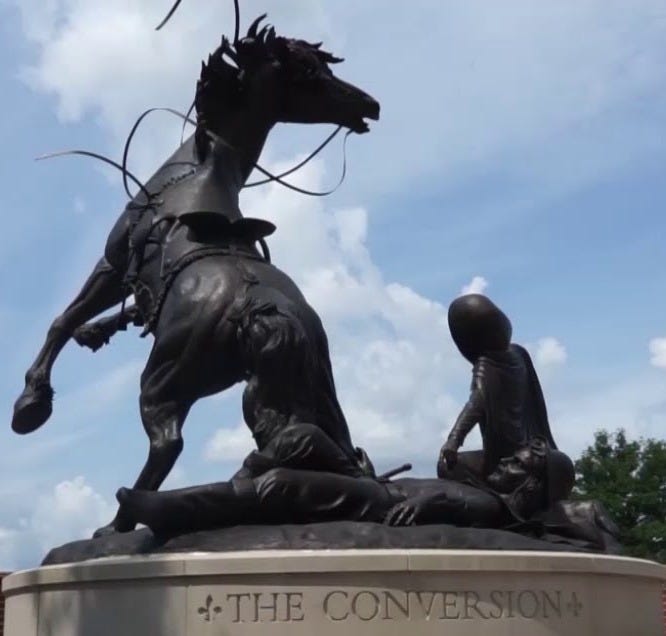
And just like the great apostle, Norbert was instantly converted.
Granted, Norbert (c. 1080-1134) was not vehemently anti-Catholic, as was Saul at the time of his conversion. Instead, Norbert was the son of a nobleman living in Catholic Germany. As the third son, he was unlikely to inherit the family estate, so his parents had decided to set him up for an ecclesiastical career. They made sure he received a good education, and when he was a grown man, he was ordained a subdeacon and became an Augustinian canon. He had no interest in becoming a priest. Instead, he was a young man merely trying to work his way up the ladder of success.
As a canon, he received a comfortable income and lived with other canons at the church in Xanten. He was intelligent, charming, and an excellent speaker, and his future prospects improved dramatically when Holy Roman Emperor Henry V took a liking to the young cleric. However, when political tensions increased between Henry and the pope, Norbert had to make a choice. Although he was not devout, he was an honest man and a good Catholic, and he took the side of the pope. He knew it would cost him.
That’s when that fateful thunderstorm confronted him with the truth about the direction his life was headed. At first, he returned to his position as a canon and began to pray, fast, and perform physical mortifications to atone for his past sins. He also began preaching about the need for repentance. The other canons were annoyed by his pious example, and he was rightly criticized when he preached outside his diocese without permission. Norbert responded by giving everything away he had: his position, his income, and his property.
But what should he do with his life? He decided to ask the pope. He traveled as a pilgrim to France and was received by Pope Gelasius II. The pope quickly recognized that Norbert was sincere, and, since Norbert recently been ordained a priest, Pope Gelasius granted him permission to preach wherever he wanted, just as he requested. This was a novel idea for the time; Saint Dominic wouldn’t found his order of traveling preachers for another century.
Norbert and three companions began traveling throughout France and Belgium. He discovered that the clergy were often living immoral lives, and the laity often did not know or practice the faith. Through his heartfelt, intelligent preaching, he reignited the spark of faith in many of his listeners.
Other men wanted to follow Norbert’s example, and another pope, Callistus II, encouraged Norbert to found a religious order for his followers. However, Norbert first had to make a choice about what kind of order he would establish. Should he follow the pattern of Augustinian canons—a group of clergy living in community near a church—or follow the pattern of monastic life of the Benedictines and the relatively new Cistercian order?
Norbert decided to establish an order of canons regular. He chose a remote valley in France called Prémontré for his first community, which is why his followers became known as Premonstratensians (also called Norbertines). Despite the fact that Norbert established an austere, penitential way of life for his young community, more and more men joined him. New houses were founded in Belgium, France, Germany, and Hungary. The pope gave his approval to the constitutions Norbert wrote to govern his order.
At about this time, a man named Tanchelm began to preach in the city of Antwerp. He claimed to be a monk, and he accused the local clergy of immoral behavior. He then claimed that the sacraments had no value because of the misdeeds of those priests, bishops, and popes. He told people not to pay tithes to the Church and insisted that they should not receive the sacraments. As the number of Tanchelm’s admirers increased, he became popular and wealthy.
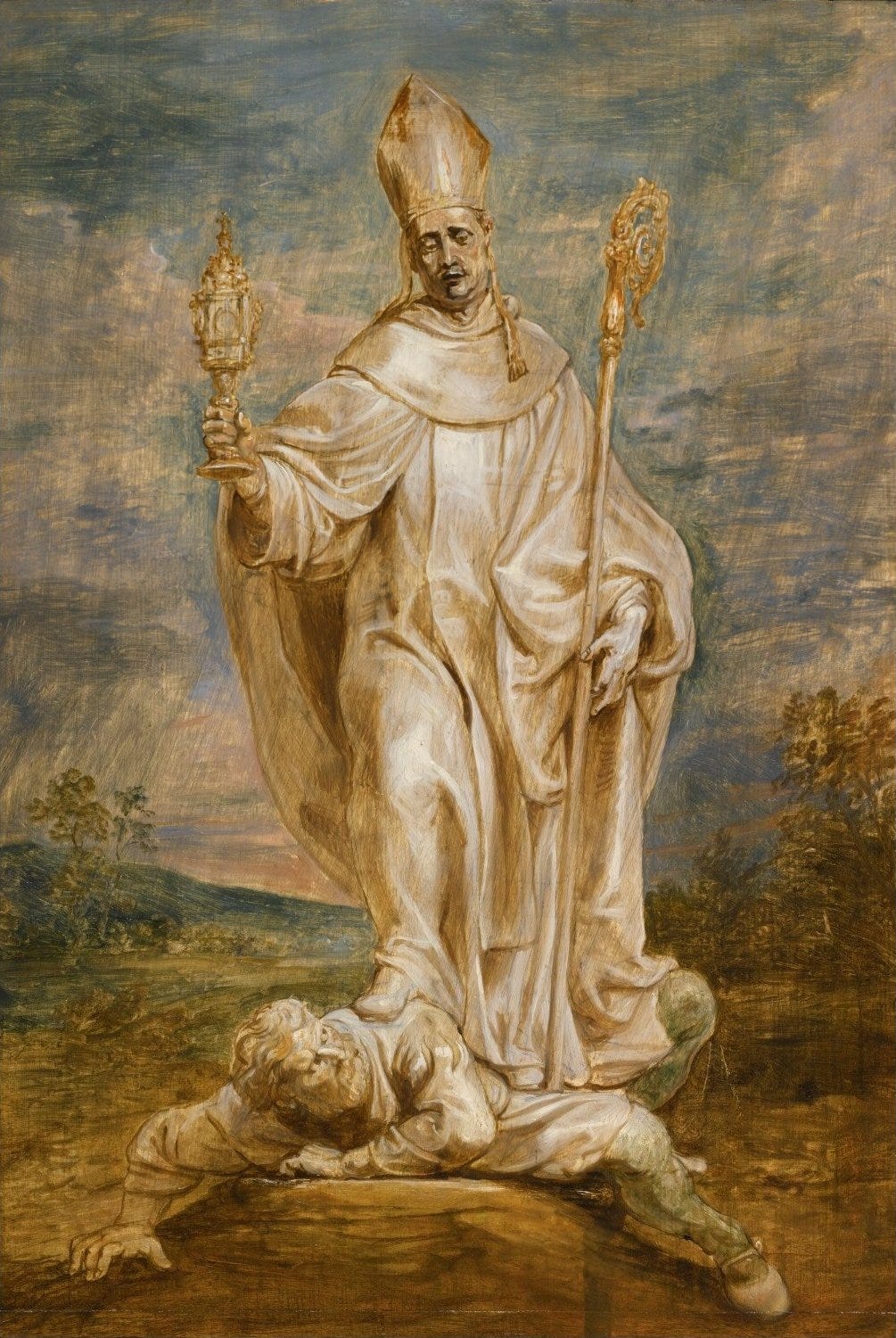
The local bishop asked Norbert to come to Antwerp and respond to Tanchelm, and Norbert immediately agreed. He preached several times in Antwerp and brought many Catholics back to the sacraments. Today, the Church responds to Tanchelm’s error by reminding us that “the sacrament is not wrought by the righteousness of either the celebrant or the recipient, but by the power of God.” (See the Catechism of the Catholic Church, no. 1128, quoting St. Thomas Aquinas.)
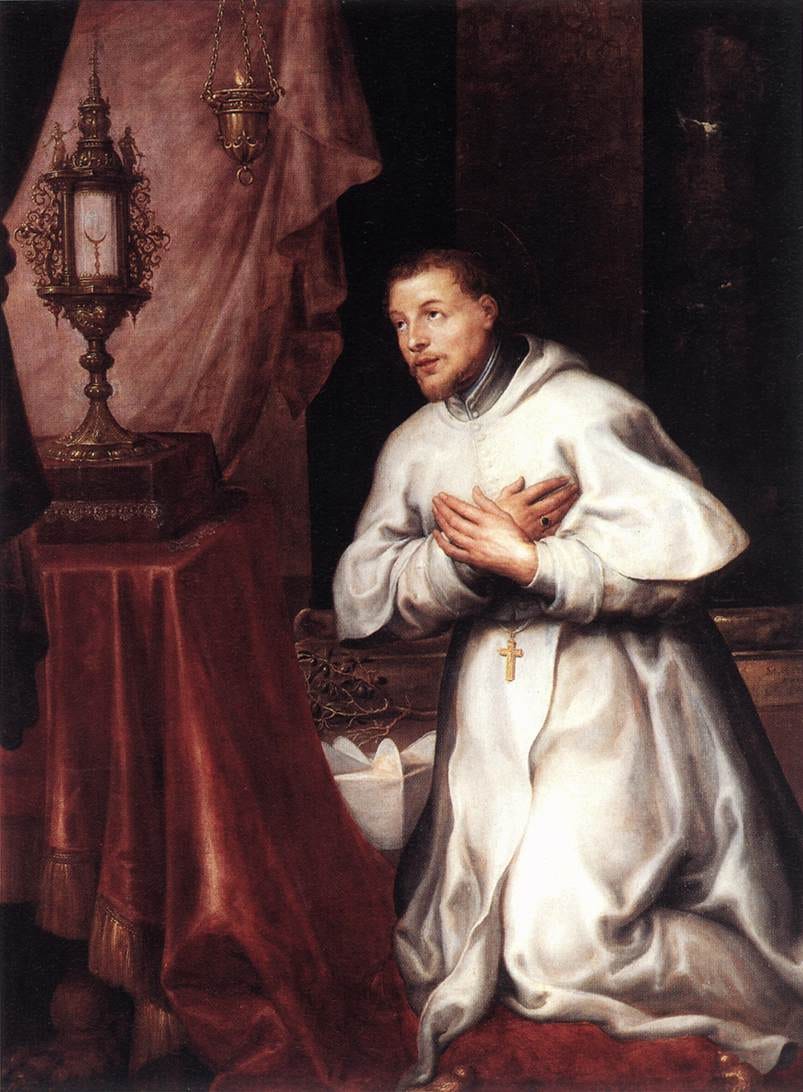
Norbert’s preaching not only defeated the heretical Tanchelm, it earned him a reputation as a defender of Catholic teaching about the Eucharist.
Although Norbert had already left behind his plans for worldly success, he was increasingly drawn into important diplomatic situations. He happened to be in the city of Magdeburg, Germany, when he was asked to preach at an imperial assembly. People were so moved by his sermon that they spontaneously decided that he was the perfect man to be elected the new archbishop of Magdeburg, since the previous archbishop had recently died.
Of course, Norbert tried to say no. Fortunately, his order had already adjusted to his frequent absences due to his preaching, and he appointed a successor to lead the Norbertine order, Blessed Hugh of Fosses.
Norbert soon discovered he faced many challenges as archbishop. Many of the clergy were living immoral lives. Wealthy nobleman had usurped archdiocesan property and refused to give it back. His archdiocese was almost bankrupt, which, of course, meant that there were no funds to care for the poor.
For that final reason in particular, Norbert fought back. He demanded that his clergy live celibate lives. He worked to restore the property of his church and brought some of the worst offenders to conversion. Other wealthy nobles had to be threatened before they would comply. His enemies did not give up easily, and assassins tried to kill him three times.
However, it was declining health, not murder, which finally brought an end to Norbert’s life. He was about fifty-nine years old when he died in Magdeburg.
We don’t know what Norbert saw when he so dramatically fell off his horse as a young man. Perhaps he saw our Lord. Whatever he encountered in that moment brought him to a profound awareness of God’s power and his weakness, and it helped him find a way to live for God, not for himself.
Norbert also realized that the way of life he had developed could help others grow in holiness. Over the past eight centuries, that way of life has produced many saints and blesseds and has spread all over the world, from Germany to India, from France to South Africa, from Spain to the Democratic Republic of the Congo, and even to America, such as the Norbertine abbey in California described here.
Saint Norbert of Xanten’s encounter with Jesus Christ after a near-death experience continues to inspire men and women to follow in his footsteps. As Saint Norbert’s modern biographer describes the Norbertine order today:
"Every year, young people present themselves at the doors of our monasteries. They desire to live a life in common, to sing and pray and work together, in poverty and joy. … Clearly, the life of St. Norbert has not yet finished and is still being written.”
Fr. Dominique-Marie Dauzet, O. Praem, The Eternal Pilgrim: A Life of Saint Norbert, trans. Fr. Nobert J. Wood, O. Praem (Manchester: Sophia Institute Press, 2025), p. 180.